Tarot Meditation — Enter Deep Awareness With a Single Card
1. What Is Tarot Meditation
Tarot meditation = take one card, treat it as a mirror, close your eyes, and 'enter' the card.
This is a profoundly deep tarot practice — it is not divination, it is spiritual practice.
Divination = you ask the card a question, the card gives you an answer.
Meditation = you become the card, let its energy flow through you, and see where it takes you.
2. Five Major Benefits of Tarot Meditation
1. Direct Contact With the 'Spirit' of the Card
Every tarot card is more than just an image — it carries 100+ years of spiritual heritage. Meditation allows you to bypass 'analysis' and receive this energy directly.
2. Enter Parts of Yourself You Haven't Seen Yet
Each card represents an archetype or state that can help you access a part of yourself you haven't fully lived yet.
3. Make Your Readings Deeper
After doing tarot meditation, when you do a reading, your interpretations will reach a deeper level — because you have directly experienced the card, not just read the textbook description.
4. Beyond the Limits of 'Literal Meanings'
The 'standard meanings' of the 78 tarot cards are limited, but the deeper energy of each card is infinite. Meditation helps you step beyond the 'standard' and tap into the 'infinite'.
5. Helps You Through Difficult Times
When life challenges you, pull the card you fear most (such as The Tower, Ten of Swords, or Death), meditate on it, and it will let you have a conversation with your fear rather than running from it.
3. The 7-Step Tarot Meditation Process
Step 1: Choose a Card
Two ways to choose:
- Method A (recommended): Close your eyes, silently repeat 'What I need to see today is ____', then shuffle and draw a card.
- Method B: Pre-select a card (such as one you've been pulling repeatedly lately, the one you fear most, or the one you most want to understand).
Step 2: Find a Quiet Space
10–20 minutes without interruption. Turn off the lights, silence your phone notifications. Light a candle or burn incense if you wish.
Step 3: Allow Yourself to Settle
Close your eyes for 1–2 minutes and let your breath settle into your body.
Step 4: Place the Card in Front of You
Place the card face-up in front of you (or hang it on the wall), then open your eyes and look at it for 30–60 seconds — no analyzing, just looking.
Step 5: Close Your Eyes and 'Enter' the Card
Close your eyes and 'enter' the card's environment in your mind:
- Imagine you are standing within the scene
- Imagine you are breathing the air of the scene
- Imagine the figures, symbols, and colors surrounding you
- Let the scene tell you what it is on its own
Step 6: Let What Emerges Happen Freely
Don't try to control it — let the imagery shift naturally:
- You might see colors
- You might hear sounds
- You might 'feel' emotions or physical sensations
- You might suddenly think of something
All of these are signals. Don't rush to 'understand' — simply observe.
Step 7: Write Down What You Received
After 10–20 minutes of meditation, immediately open your journal or notebook and write down anything that surfaces — don't filter, don't organize.
4. Four Common Ways to 'Enter' a Card
Way 1: Visual Entry
The most direct method — imagine you stand inside the scene. This works best with visually clear cards (The Empress, The Star, The Tower, etc.).
Way 2: Elemental Entry
Feel the elements of the scene:
- Fire (Wands) — imagine heat, light, movement
- Water (Cups) — imagine tides, flowing emotions
- Air (Swords) — imagine thoughts flying past
- Earth (Pentacles) — imagine being rooted, steady
Way 3: Character Entry
If you draw a figure card (Court Cards, The Emperor, The Empress, etc.), imagine you become that person and see the world through their eyes.
Way 4: Symbolic Entry
Tune into the card's symbols (animals, plants, geometric shapes) and let them carry emotion.
5. Five Cards Best Suited for Meditation
1. The Fool (0)
Keywords: New beginnings, emptiness, freedom
Meditation effect: Enter 'the state of emptiness' and let 'the next action' surface.
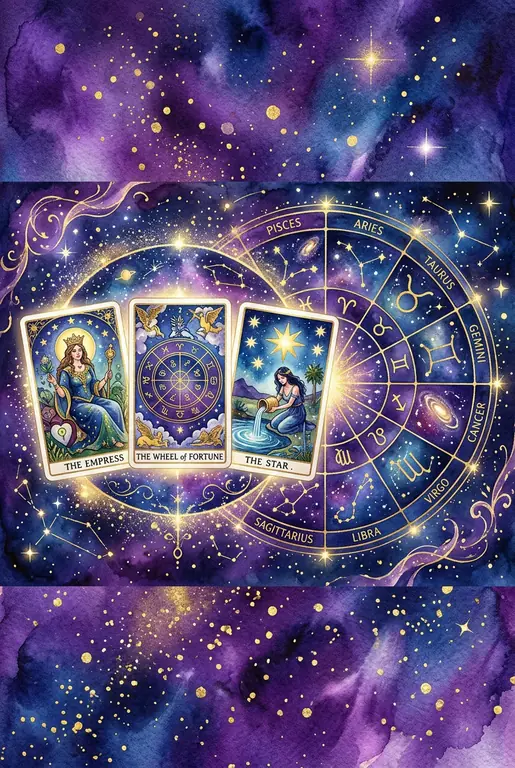
2. The Empress (III)
Keywords: Nurturing, abundance, nature
Meditation effect: Enter 'being embraced' and heal any wounds of 'not being loved'.
3. The Hermit (IX)
Keywords: Solitude, inner light, guidance
Meditation effect: Enter 'the lighthouse' — a lamp lights up within you, guiding your way.
4. Death (XIII)
Keywords: Transformation, endings, release
Meditation effect: Enter the stillness of 'no longer needing' and release what is old.
5. The Star (XVII)
Keywords: Hope, serenity, purity
Meditation effect: Enter 'the quiet of the cosmos'. This is an extraordinarily healing card.
6. Four Common Signs During Meditation
Sign 1: Sudden Emotional Surges (Tears, Anger)
This is the most common sign — you are in direct contact with the card's energy, and that energy triggered some 'memory or feeling' within you.
Don't tense up. Let it happen — you'll be fine once the tears pass.
Sign 2: Suddenly Remembering Something You 'Hadn't Thought About in Ages'
This is the subconscious surfacing. You thought you'd forgotten, but you hadn't — this matters, and is worth following up on tomorrow.
Sign 3: Discomfort in a Specific Part of the Body
This is 'body memory'. For instance, meditating on The Tower may bring tightness to your chest — a sign of unexpressed emotion.
Sign 4: A Sudden, Clear 'Sentence' or 'Image'
This is your inner wisdom delivering a message. Usually brief, but strikingly accurate. Write it down immediately when you come out of meditation.
7. Four Common Misconceptions About Tarot Meditation
Misconception 1: Expecting a 'Transcendent Experience'
Most people see nothing when they meditate on tarot — and that's completely normal. 'Seeing nothing' is also a complete meditation.
Misconception 2: Over-Interpreting Every Image That Surfaces
Don't treat every image as a 'profound prophecy'. Most imagery that arises during meditation is mental chatter, not the spirit of the card.
Misconception 3: Meditating on 'Difficult Cards' When You're Already Depleted
If life has already drained you today, don't sit with 'The Tower,' 'Death,' or the 'Ten of Swords' — you'll only make things worse.
Meditate on gentler cards like 'The Empress,' 'The Star,' or 'The Sun' first, and tackle the 'tough ones' when you're in better shape.
Misconception 4: Trying Hard to Force Images to Appear
Meditation is not 'trying to see something'. It is 'allowing images to surface naturally'. Forcing creates tension, which blocks the very thing you're after.
8. Tarot Meditation vs. Reading — A Comparison
| Dimension | Reading | Meditation |
|---|---|---|
| Purpose | Receive an answer | Enter a state |
| Duration | 5–30 minutes | 10–30 minutes |
| Requires a question | Yes | No |
| Output | Interpretation | Experience |
| Frequency | As needed (1–3x weekly) | Daily or weekly |
| Best for | You have a specific question | You want deeper growth |
Ideally, do both — a reading gives you an external response, meditation gives you an inner experience. They complement each other.
9. A Final Note
Tarot meditation is the practice I recommend most often to students who feel 'stuck'.
Many who study tarot plateau at 'I don't get the cards' — not because they lack understanding, but because they haven't engaged the cards with their body or soul — only with their mind.
Try a different way of connecting: don't read the textbook meanings — enter the picture. Don't memorize 'standard answers' — let the scene tell you itself.
Meditating 10 minutes a day for 30 days, you'll understand tarot better than after 100 hours of coursework.
Our Liora Moon app features 78 high-definition card images — you can enter meditation directly on your phone, zoom into a card, and breathe alongside its energy.
May your tarot meditation reveal the part of you that has always been waiting to be seen.
Related links:
For reference only. Tarot meditation is not a religion. For entertainment purposes only.🔮 This reading is for entertainment purposes only. Want to try tarot? Visit lioramoon.com