Tarot Journaling — Reshape Your Tarot Practice with a Daily Journal
1. Why Tarot Must Be Paired with a Journal
Many who study Tarot study a lot, but retain nothing.
You have learned all 78 cards, read five books, taken three courses, but a year later when asked: "Which cards do you use most often?" — most people can't name five.
This isn't because you're not smart — it's because there's no 'sedimentation' mechanism.
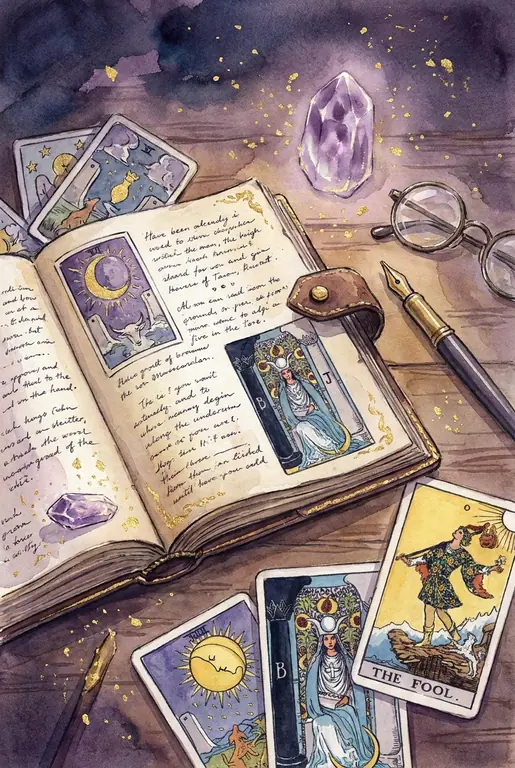
A Tarot journal is that sedimentation mechanism: it lets you write down your daily conversations with the cards, turning them into your personal Tarot knowledge base.
2. The 4 Types of Tarot Journals
Type 1: One-Card-a-Day Journal (The Most Basic)
Each morning, draw one card and write down:
- The card you drew
- 1–3 things that happened today
- How the card corresponded to those events
- Your own reflection
Type 2: Themed Journal (More Systematic)
Choose a theme and draw and record a card every day for 30 days:
- Theme 1: "My relationship with him/her over the past 30 days"
- Theme 2: "My health over the next 30 days"
- Theme 3: "My finances over the next 30 days"
- Theme 4: "My inner growth over the next 30 days"
Type 3: Card Reflection Journal (Deeper)
Pick one card and write your conversation with it for 7 consecutive days:
- Day 1: My first impression of this card
- Day 2: An event today that this card reflects
- Day 3: A childhood/past memory this card evokes
- Day 4: A future/longing this card conjures
- Day 5: The state I was in when I last drew this card
- Day 6: What is the "shadow" of this card
- Day 7: My final understanding of this card
Type 4: Spread Result Journal (Write After a Reading)
Every time you complete a complex spread (Celtic Cross, Love Spread), write all the cards and their relationships to each other as a "story."
3. The 8 Key Principles of Journaling
Principle 1: Write the Same Day — Don't Delay
What happens today, write it today. Tomorrow, your memory will warp.
Principle 2: Short Beats Long
30 seconds beats zero seconds. Start with a single sentence; a paragraph will come naturally over time.
Principle 3: Write in the First Person
Write with "I", not "the Tarot says" or "this card says" — you are having the conversation, not "it."
Principle 4: Don't Chase "Pretty"
A journal isn't for anyone else to read, so don't ask yourself "is this good enough?" Authenticity is what matters most.
Principle 5: Write by Hand, Not Keyboard
Research shows handwriting is more memorable than typing. You remember what you write. But if keyboards are all you know, use them — consistency matters more than perfection.
Principle 6: Preserve the Raw Record
Don't beautify, edit, or filter. Your initial feelings are the most valuable part.
Principle 7: The 7-Day Review
Every Sunday, spend 10 minutes reviewing this week's seven entries and write down "the core theme of this week."
Principle 8: The 30-Day Big Review
At the end of each month, reread the entire month's journal and write "the single biggest thing I've learned."
4. The 3 Common Tarot Journal Templates
Template 1: Minimalist (1 Minute a Day)
Date: ____
Card: ____
Most important thing today: ____
How the card corresponds: ____
Template 2: Standard (5 Minutes a Day)
Date: ____

1. Morning mood (1–10): ____

2. Card drawn: ____ (Upright / Reversed)
   First-feeling keyword for the card: ____

3. Three things that happened today:
   - ____
   - ____
   - ____

4. How do these events mirror the card?
   - The card says ____
   - In the event ____

5. How I feel right now (one sentence): ____

6. What I want to say to myself today: ____
Template 3: Deep Dive (Once a Week)
Date: ____

The 7 cards drawn this week:
  Monday: ____
  Tuesday: ____
  ...
  Sunday: ____

1. The "story" of these 7 cards (one sentence): ____

2. The week's repeating theme: ____
   (any card repeats / any element clusters / any suit clusters)

3. My "energy shift" this week (Monday → Sunday): ____

4. One thing I learned this week: ____

5. My "invitation" for next week: ____
5. How to "Mine Gold" from Your Journal
After six months of journaling, you'll start to see patterns:
Mining Method 1: Repeating Cards
If a card shows up 2–3 times a month, that is "your card." Worth a deep dive.
Mining Method 2: Repeating Elements
If you frequently draw fire (Wands), your year's main melody is "action / entrepreneurship / new beginnings."
If you frequently draw water (Cups), your year's main melody is "relationships / emotion / connection."
Mining Method 3: Repeating "Themes"
If your journal keeps circling words like "see clearly," "clarity," "vision," the cards are saying "you are seeing something important."
Mining Method 4: Repeating "Emotions"
If your journal keeps surfacing words like "tired," "pressure," "no time," then both the cards and your body are telling you "you need rest."
Mining Method 5: The "Turning Point"
If your 30-day journal dips in the first two weeks and rises in the last two, that is a "complete story" — you are undergoing real transformation.
6. The 8 Common Pitfalls in Tarot Journaling
Pitfall 1: Writing Too Perfectly
A "too perfect" journal is written for others, not yourself. A real "today I drew the Tower, and I was terrified" is far more valuable than "today I drew the Tower, the universe is telling me XXX."
Pitfall 2: Writing Too Much
A "30-minute journaling session" will kill your consistency. 30-second entries are far more sustainable.
Pitfall 3: Quitting After Missing a Day
Missing one day, or three, is fine. Just keep going.
Pitfall 4: Mixing Everything Together
The journal must be sorted: keep your Tarot journal separate from a regular diary. Otherwise you'll lose track.
Pitfall 5: Over-Reliance on Online Templates
Templates are scaffolding — eventually you must outgrow them. Your journal should grow into its own shape.
Pitfall 6: Letting Nobody Read It
A journal doesn't have to be public, but you can choose a trusted person to share with — it's a "growth accelerator."
Pitfall 7: Writing Without Reviewing
"Review" is the most important part of journaling. Writing without reviewing = wasted effort.
Pitfall 8: Comparing with Others
Don't look at someone else's "my journal is so beautiful." Write your own.
7. Tarot Journaling + the Liora Moon App
Our Liora Moon app streamlines your journaling workflow:
- Daily card draw: auto-logged with one tap
- 6 languages: you can write your journal in Chinese / English bilingually
- "Today's Hint" for each card: copy it straight into your journal
- Monthly review: automatic summary of every card drawn each month
You don't need to do all the writing yourself — the app prepares 90% for you, and you only need to contribute 10% in reflection.
8. A Closing Note
The Tarot journal is the cheapest, most effective, and longest-lasting method of Tarot practice.
It won't make you stronger overnight, but half a year later you'll find yourself:
- Reading a card and immediately sensing its energy
- Glancing at life and instantly knowing which card it mirrors
- Telling friends about Tarot with actual stories to share
Your relationship with Tarot, through journaling, becomes your real wealth — not the empty phrase "I've studied Tarot."
Related links:
For reference only. The Tarot journal is a practice, not a ritual. For entertainment purposes only.🔮 This reading is for entertainment purposes only. Want to try tarot? Visit lioramoon.com