How to Shuffle and Meditate — The Complete Pre-Tarot Ritual
1. Shuffling Is More Than Just "Mixing the Cards"
Many beginners think shuffling is just randomizing the deck. In reality, shuffling is the most sacred, most crucial step in Tarot — it's how you imprint your energy onto the cards, letting them "receive your question."
Without proper shuffling, the cards you draw carry little energy. The more intentional your shuffle, the more you'll enter Tarot's "conversational state."
2. The 5 Core Principles of Shuffling
1. Settle Yourself First for 30 Seconds
Don't pick up the cards and start shuffling right away. Sit down first, silence your phone notifications, and give yourself 30 seconds of stillness.
These 30 seconds nearly determine the quality of your entire reading. I've seen two identical cards (both The Hierophant upright) drawn in completely different states — one from a calm mind, one from anxiety — and their interpretations were nothing alike.
2. Let the Question Surface
Before shuffling, ask yourself one specific question. Let that question fully exist in your mind.
Example: "Regarding my relationship with him over the next 3 months, what do I need to see?"
3. "Place" the Question Into the Shuffle
While shuffling, silently repeat your question (or hold it in your heart).
Silent repetition works better than speaking aloud — because it deepens your focus. Your question gets "stamped" onto every card during the shuffle.
4. Make the Physical Action Complete
- Shuffle for at least 30 seconds (quickly, but thoroughly)
- Shuffle at least 7 times (a nod to the 7 in Tarot symbolism)
- Or, go by "feel" — you'll know yourself when it's "enough"
5. Pause for 1 Second Before Drawing
After shuffling, pause for 1–2 seconds. That one second lets your subconscious "tell you" which card to draw. Then draw.
3. 4 Common Shuffling Methods
Method 1: Standard Riffle (Most Common)
Divide the deck into two piles, push one into the other. Repeat 7 times.
Best for: Shuffling 78 cards with the least hand strain.
Method 2: Overhand Shuffle (Poker Style)
Split the deck in half and "interleave" them. This is the classic "poker shuffle."
Best for: Speed, but watch out for corner wear.
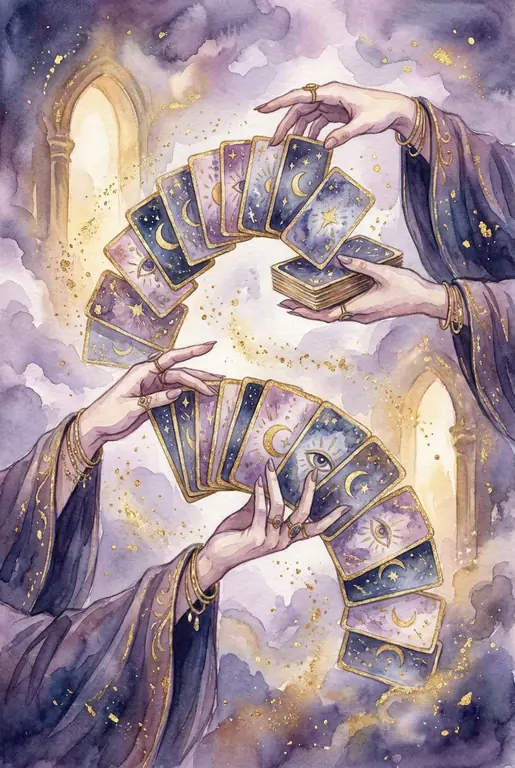
Method 3: Spread Shuffle
Place the cards face-down on the table, push them apart like a fan with both hands, then gather them up arbitrarily. This shuffle scatters easily — mind your cards.
Best for: Letting "energy disperse," ideal for readings when you're emotionally scattered.
Method 4: "Reshaping" Shuffle (Advanced)
Spread the cards fully open, then "reshape" them back into a deck — as if you're "re-shuffling a span of time." This method takes the longest but feels the most powerful.
Best for: Before important readings.
4. 4 Common Shuffling Mistakes
Mistake 1: Shuffling Too Forcefully
Many beginners shuffle very aggressively, thinking "force = intention." In truth, forceful shuffling = physical damage to the cards + draining your own energy. What matters is gentle, repetitive, steady.
Mistake 2: Not Silently Repeating Your Question
If you only use physical motion, your question never gets imprinted, and the cards "don't know what to give you." Silent focus is essential.
Mistake 3: Shuffling for Too Long
10 minutes of shuffling isn't necessary. 30 seconds to 1 minute is enough — the key is focus.
Mistake 4: Hesitating When Drawing
After shuffling, you're mid-draw, and suddenly wonder, "Should I restart?" — that's a signal of self-distrust. Trust the first card you touch. That is your card.
5. "Preparation" Steps After Shuffling
Before drawing, you can do a "preparation action":
Option A: Cutting the Deck
Split the deck in half and stack them together. This step balances your energy more evenly and honors an ancient Tarot tradition.
Option B: Read Your Question One Last Time
Before drawing, read your question one final time — aloud or silently — letting it crystallize one last time.
Option C: Breathe Before Drawing
Take 3 deep breaths, let your rhythm settle. Then draw.
I'd recommend choosing one — you don't need to do all three.
6. 4 Basic Ways to Draw Cards
Method 1: Top Card
After shuffling, take the top card — the "freshest energy," ideal for "present-moment" questions.
Method 2: Random Position
After shuffling, draw arbitrarily — the "subconscious choice," ideal for "deeper questions."
Method 3: Counting Draw
After shuffling, silently repeat your question, and starting from the top (or any point), count to a number within your question (e.g., you're 28 → count to 28). This method is ancient, but feels rather "mechanical."
Method 4: Fan Draw
Spread the cards in a fan shape, close your eyes and pick one — fully random, ideal for "major questions."
I usually go with Method 2 (random position) — it's the most natural and makes it easiest for intuition to surface.
7. The "Sacredness" of Shuffling — Ritual Mindset
Ritual isn't superstition; it's a way to bring your body into the right state.
Elements — 5 Things That Enrich a Tarot Ritual
- A candle: A simple candle representing "the light within" (lit or unlit)
- A glass of water or tea: Representing "flow" / "clarity"
- A pen + a journal: Representing "what you'll write next"
- A cloth or scarf: To lay your cards on, giving them a "home"
- Silence / nature sounds: A quiet environment, or low-volume nature audio
You don't need all of them — pick 1–2 that resonate most with you.
8. A Note for the "No-Ritual" Crowd
If you feel rituals are a hassle, that's completely fine. Rituals are a support, not a requirement.
The 3 most important things — stillness + silent question + entering "conversational state." These 3 things require no candles, no cloth, no incense.
The most skilled reader I know simply sits at her desk, closes the laptop, thinks her question, closes her eyes — she has no props, and needs none. Her Tarot work is still remarkably accurate.
So don't let "ritual pressure" bind you. It's meant to help you, not to chain you.
9. Shuffling Techniques for Different States
When You're Calm
Standard shuffle, 30 seconds, silently repeat your question, draw. Business as usual.
When You're Anxious
Spread shuffle — scatter the cards wide, let the "anxiety" disperse with them. Then take 3 deep breaths and draw.
When You're Emotionally Overwhelmed (Anger, Grief)
Pause the reading. Wait 1–2 hours to cool down, or try again tomorrow. Cards drawn in emotional storms are chaotic and unreliable.
Before a Major Reading (e.g., Should We Break Up?)
Reshaping shuffle — spread the cards wide, gather them back slowly, giving the reading "more weight." Then breathe deeply, close your eyes for 1 minute, then draw.
10. A Final Note: The Ritual Is for You, Not for the Cards
Tarot doesn't need ritual to "work" — but ritual helps you prepare for the conversation.
The most important ritual is always "the stillness within you." That can't be replaced.
Turning your phone off for 30 seconds, sitting at your desk silently repeating your question, taking 3 deep breaths — this most humble ritual is sometimes more powerful than a room full of candles.
Our Liora Moon app has a "Focus Mode" — when you open it, it gives you 3 seconds to breathe before drawing. It's the smallest ritual we can offer — we hope those 3 seconds are what bring you into the conversational state.
May your daily 3 seconds always bring you back to yourself.
Related Links:
For entertainment purposes only. This article is for reference; ritual is a support, not a requirement.🔮 This reading is for entertainment purposes only. Want to try tarot? Visit lioramoon.com