The Origins and History of Tarot — From 14th-Century Italy to the 21st-Century World
I. Tarot Was Not "Always There"
Many people assume Tarot is an ancient mystical tradition thousands of years old, but Tarot's history is actually shorter than Christianity's.
The earliest documented records of Tarot cards date to 15th-century northern Italy (around the 1440s), and they were originally not a divination tool — they were a game.
Yes, Tarot was first and foremost a game.
Italians played Tarot as a card game (Tarocchi, similar to bridge or poker), and the idea of using Tarot for divination came much later.
II. The Visconti Family: The "Prototype" Version of Tarot
The oldest surviving Tarot deck is the Visconti-Sforza Tarot, commissioned by the Visconti and Sforza families, the ruling dynasties of 15th-century Milan, Italy.
At that time, Tarot cards were hand-painted works of art created by court painters for the nobility, with a full 78-card deck costing a fortune. Tarot was a luxury item, accessible only to the aristocracy.
The earliest versions did not contain the Major Arcana archetypes we know today such as The Fool, The Wheel of Fortune, Justice, or Strength — these mystical meanings were added only after the 18th century.
III. 1781: French Mystic Jean-Baptiste Alliette (Etteilla)
In 1781, French mystic Jean-Baptiste Alliette (pen name Etteilla — which is "Tarot" spelled backwards) published the first book dedicated to Tarot divination, titled Comment je me suis trouvé en possession du véritable Tarot de nos anciens. This is when Tarot officially became a divination system.
He was also the first reader to systematically correlate each card with different areas of life (love, career, health, spirituality).
IV. 1888: The Hermetic Order of the Golden Dawn and the Marseille Tarot
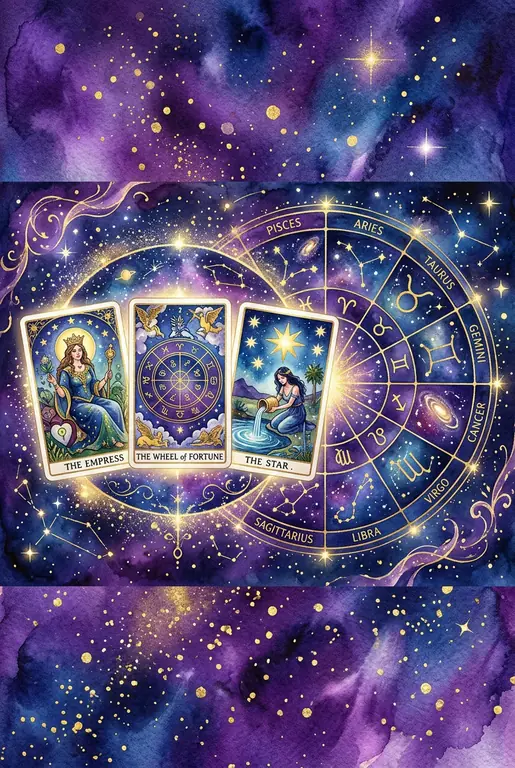
In 1888, the Hermetic Order of the Golden Dawn formally linked Tarot with Kabbalah, Hermeticism, and Astrology.
The most important contributions of this generation of mystics include:
- Mapping the 22 Major Arcana cards to the 22 letters of the Hebrew alphabet
- Mapping the four suits to the four elements (fire, water, air, earth)
- Mapping the 22 Major Arcana cards to the twelve zodiac signs plus ten planets
- The Astrological Tarot system (a fusion of astrology and Tarot)
The Rider-Waite-Smith Tarot (1909) remains the most iconic deck from this era. It is the most widely used Tarot deck in the world today, and it is also the default deck in our Liora Moon app.
V. The 20th Century: Tarot's Modern Transformation
Two pivotal shifts took place in the 20th century:
1. The Marriage of Psychology and Tarot
Carl Jung was the key figure who brought Tarot into the realm of psychology. He believed the archetypes within Tarot reflected the collective unconscious, and reading the cards was essentially "a dialogue with your own psyche".
His work inspired a generation of self-help-oriented Tarot readers (such as Mary K. Greer), shifting Tarot from pure mysticism toward a tool for personal growth.
2. Tarot in the Women's and LGBTQ+ Movements
From the 1960s to the 1970s, Tarot moved out of the mystical world and into everyday life. Within the women's movement and the LGBTQ+ movement in the United States and Europe, Tarot became a tool for self-empowerment — no longer just "divination," but rather "a dialogue with my own destiny."
This era produced many influential female Tarot readers (such as Rachel Pollack), broadening Tarot's language and imagery to become far more inclusive.
VI. The 21st Century: Globalization and Digitalization of Tarot
In the 21st century, Tarot has evolved along several clear trajectories:
1. Digital Readings
The smartphone era made Tarot accessible to the masses for the first time in history. Liora Moon is a product of this era — allowing anyone, anywhere, to connect with the cards at any time, without needing a physical deck, a professional reader, or a face-to-face session.
2. Multicultural Tarot Decks
Beyond traditional Western European Tarot, Asian, Latin American, and African traditions have all developed their own Tarot systems. These localized decks are transforming Tarot from a "European mystery tradition" into a "worldwide mystical art."
3. Tarot as a Mental-Health Tool
An increasing number of psychotherapists use Tarot as a "mirror" for reflection, while coaches use it as a questioning tool. Its role is becoming more akin to a self-reflection tool for the AI age.
VII. Key Milestones in Tarot History
| Year | Event |
|---|---|
| ~1440 | The earliest Tarot cards appear in northern Italy |
| ~1450 | The Visconti-Sforza deck is documented (the earliest physical evidence) |
| 1781 | Etteilla publishes the first book on Tarot divination |
| 1888 | The Hermetic Order of the Golden Dawn links Tarot to Kabbalah |
| 1909 | The Rider-Waite-Smith Tarot is published, becoming the modern standard |
| 1949 | Carl Jung passes away; his Tarot theory shapes 20th-century psychology and Tarot |
| 1969 | Rachel Pollack publishes 78 Degrees of Wisdom |
| 2000s | Digital Tarot begins to emerge |
| 2010s | Mobile Tarot apps become widespread |
| 2020s | Tarot + AI + multilingual + global localization |
VIII. The Two Traditions of Tarot: Mystical and Psychological
Modern Tarot essentially follows two main traditions — not opposing, but complementary paths:
The Mystical Tradition
- Links Tarot with Kabbalah, Astrology, and Hermeticism
- Emphasizes the "mystical meaning" of the cards
- Suited for those drawn to "star charts, energy, and destiny"
The Psychological Tradition
- Views Tarot as a "mirror" for self-reflection
- Emphasizes that "the cards themselves carry no meaning — I project meaning onto them"
- Suited for those seeking "self-reflection and decision support"
A skilled reader understands both traditions, knowing which tool to use at the right moment.
IX. Why Has Tarot Survived for 600 Years?
Tarot is not a religion (religion requires "belief"); Tarot is an empirical tool — you only need to try it, and it will respond to you.
Across 600 years, no matter what era, fad, or belief system dominated the world, Tarot has always held a stable place. It has endured:
- The Enlightenment (when it was dismissed as superstition)
- The age of psychology (when it was reframed as a mirror)
- The digital age (when it was moved into apps)
Because humans will always need a mirror, and Tarot is that mirror.
X. Closing Thoughts
At Liora Moon, we are part of this 600-year story, carried forward by our generation.
Every time you open the app, draw a card, no matter what card appears, you are in conversation with the Visconti nobility of 1440, with Etteilla of 1781, with Waite of 1909, with Rachel of 1969. What you draw is not a cold image, but six centuries of accumulated wisdom on "how to see yourself."
The history of Tarot is the history of humanity "exploring itself" — and you are part of that history.
Related Links:
This article is for reference only. Tarot is not a scientific discipline.🔮 This reading is for entertainment purposes only. Want to try tarot? Visit lioramoon.com
For entertainment purposes only